Choosing between a single-sided and a double-sided feather flag comes down to a balance between directional visibility, budget, and outdoor aerodynamics. While double-sided flags guarantee correct reading from every angle, the physical weight of the banner significantly influences how the flag flies, how much stress it puts on your hardware, and how long the fabric lasts.
Here is an engineering and marketing breakdown to help you select the right format for your location.
How Single-Sided Flags Work: Single-Reverse Printing
Single-sided flags are printed on a single layer of lightweight polyester fabric.
- The Print Mechanism: The ink penetrates deeply through the textile, producing a vibrant image on the front and an approximately 80% to 90% bleed-through on the back.
- The Backside View: The reverse side displays the graphic mirrored and backward.
- Best Applications: Single-sided printing works well for bold, recognizable logos, universal symbols (such as arrows, food icons, or sale emblems), or locations where traffic only approaches from one primary direction (such as one-way roads or building entrances).
Because single-sided flags use only one layer of lightweight polyester, they catch gentle breezes easily and exert minimal drag on the pole assembly.
How Double-Sided Flags Work: Integrated 3-Ply Composite Construction
Rather than sewing separate loose pieces of cloth together, a true double-sided feather flag is crafted from a specialized 3-ply composite material. Three distinct layers—a white printable face, an opaque black core, and a second white printable face—are welded and woven together to create functionally a single, unified piece of fabric.
- Zero Pass-Through: The dense black center piece acts as a total light barrier, completely preventing pass-through and show-through from the opposing side.
- Crystal-Clear Readability: Because light cannot penetrate the core, text, phone numbers, and fine-line graphics read cleanly and correctly from both directions with zero ghosting or mirror effect, even under direct, brilliant sunlight.
- Unified Strength: Welded into one cohesive textile, the material will not blister, separate, or bubble in outdoor conditions.
Double-sided flags are ideal for two-way streets, commercial boulevards, and open parking lots where drivers and pedestrians approach from both directions simultaneously.
Precision Edge Finishing: Heat-Cutting to Prevent Wind Tear
Durability in high winds depends heavily on how the edges are finished. Instead of traditional needle-and-thread folded hemming, double-sided flags utilize an advanced heat-cutting method:
- Fused Perimeter: The heat-cut technique uses thermal sealing to melt and fuse the synthetic polyester edges cleanly at a microscopic level, creating a sealed border that cannot fray or unravel.
- Eliminating Needle Perforations: Traditional sewn hems punch thousands of needle holes along the edge, creating weak stress points that tear apart when the flag whips in turbulent wind. Heat cutting leaves the edge completely intact and perforation-free.
- Aerodynamic Wind Release: Without bulky, heavy hem folds catching the air, the heat-sealed edges allow wind to spill off the banner smoothly, significantly reducing whipping stress and preventing edge tears.
The Engineering Difference: Why Single-Sided is 11.5' x 3' and Double-Sided is 10' x 2.5'
When comparing Vista Flags' standard flagship models, you will notice a difference in banner dimensions:
- Single-Sided Banner: Measures 11.5 ft tall by 3 ft wide.
- Double-Sided Banner: Measures 10 ft tall by 2.5 ft wide.
Both models mount onto the exact same heavy-duty sectional pole kit, but the double-sided flag is engineered with smaller surface dimensions for a critical reason: weight.
1. Managing Fabric Mass and Aerodynamic Drag
A single-sided flag uses one layer of 65gsm knitted polyester. A double-sided flag uses a 3-ply welded composite textile (white/black/white) that integrates three functional layers into functionally one piece of fabric. This heavy-duty composition effectively triples the material weight of the banner.
2. Protecting the Pole and Perimeter Seams
When a feather flag flies in 15 to 25 MPH winds, heavy fabric creates substantial aerodynamic drag. If a heavier 3-ply composite double-sided banner were produced at the full 11.5' x 3' dimension, the sheer mass of the fabric would:
- Place excessive bending torque on the flexible fiberglass top whip.
- Exert heavy downward friction against the rotating base spindle.
- Accelerate stress along the top curved sleeve and lower tension corners.
3. Preserving Product Lifespan
By proportionally sizing the double-sided flag down to 10 ft x 2.5 ft, Vista Flags reduces the overall surface area and counterbalances the added material weight. This targeted adjustment keeps the mechanical load on the pole hardware identical to that of a single-sided flag, preventing pole snapping and ensuring the expected 3-to-6-month daily outdoor lifespan remains fully intact.
Feature Comparison
| Feature | Single-Sided Flag | Double-Sided Flag |
|---|
| Dimensions (Full-Size Flag) | 11.5 ft x 3 ft | 10 ft x 2.5 ft |
| Total Height on Pole | ~15 ft | ~11 ft |
| Fabric Construction | 1 layer knitted polyester (open bleed-through) | 3-ply welded composite (white/black/white in 1 fabric) |
| Edge Finishing | Hemmed border | Precision heat-cut edge (prevents wind fray & tear) |
| Reverse Side Visibility | Mirrored / backward text (~80% opacity) | 100% correct reading (zero pass-through) |
| Overall Banner Weight | Ultra-lightweight | Medium / heavy |
| Breeze Responsiveness | Flutters in light breezes | Needs moderate wind to flutter |
| Wind Load on Hardware | Low | Balanced (via 10'x2.5' profile) |
| Cost | Budget-friendly | Premium |
Which Style Should You Choose?
Choose Single-Sided (11.5' x 3') if:
- You are operating on a tight marketing budget and want maximum square footage of color for the lowest price.
- Your display features simple, high-contrast wording (like "OPEN", "TIRES", or "SALE") that is easy to decipher even in reverse.
- The flag sits against an exterior wall or fence where traffic only views it from one angle.
- Your area experiences frequent low-wind days, where a lighter fabric flutters more readily.
Choose Double-Sided (10' x 2.5') if:
- Your display is positioned on a two-way street or a highway median where traffic travels in opposite directions.
- Your artwork contains detailed text, directional arrows, contact numbers, or specific brand logos that must be legible from every angle.
- You need zero image bleed-through or pass-through under direct midday sunlight.




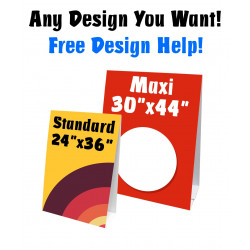 Custom Economy 24" x 36"... Custom Economy A-Frame Size-Standard (24" x 36"), Custom Economy A-Frame Sandbag-Yes (Include Sandbag Weight)$89.99
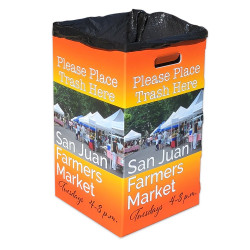 Custom Printed Trash,... Trash or Recycle Bin Size-30 Gallon, Trash or Recycle Bin Lid-No Lid$69.99